Self-directed
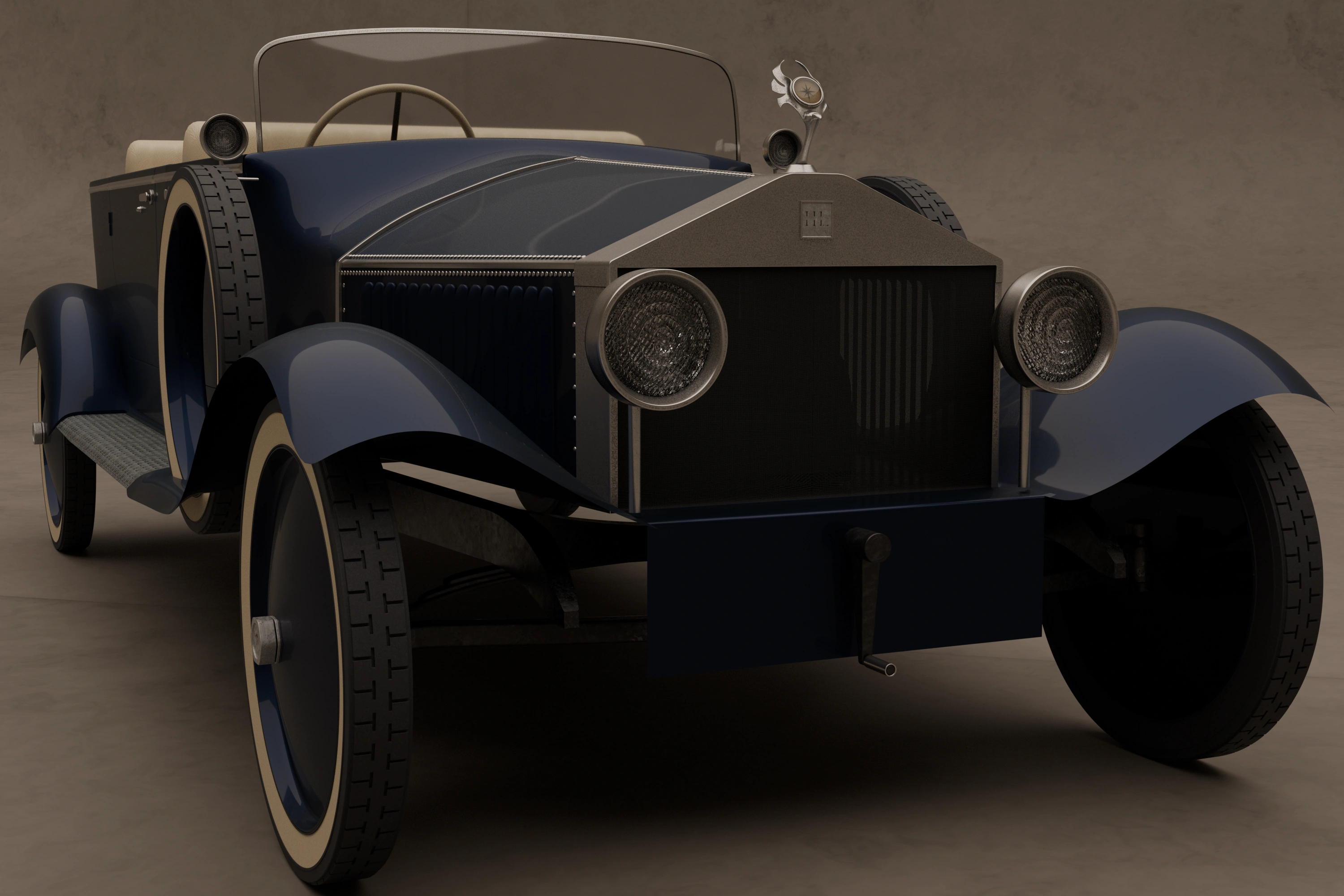
A 1919 Silver Ghost taken from blueprint to shipping asset under a 25,000-triangle brief - which is the wrong budget for a car, and the reason every decision below is about where curvature was worth paying for.
Reference to blockout
Orthographic blueprints to resolved mass. Proportion and stance are the only things settled here, because they are the only things that cannot be fixed later.
The reference board
Gathered before any modelling. The orthographic plates are the ones that were worked from; the rest settled arguments about details the plates do not resolve.
Proportion passes
Mass and stance resolved before any detail exists to defend.
What the blockout is for
A car is judged on stance before it is judged on anything else, and stance is a relationship between the wheelbase, the ride height and the mass over each axle. Getting it wrong here is not a detailing problem later, it is a rebuild - every panel after this is cut to the volume the blockout establishes. So the blockout carries no detail on purpose. There is nothing in it to fall in love with and nothing that makes moving a form expensive, which is the only state in which proportions actually get changed.
High-poly detailing
54 million triangles, spent almost entirely on things that will not ship as geometry. The sculpt is not the deliverable - it is the source the deliverable is baked from.
The sculpt
Where the coachwork earns its keep: panel gaps, beading, chrome.
Where 54 million went
Almost none of it went where a viewer would guess. A single tyre is roughly 300,000 triangles before the rim is counted - tread blocks on a period tyre are dozens of discrete forms repeated around a circumference, and there are four of them. The rest went into rivets, the beading along the coachwork, and the wrinkles and folds in the leather seats. Every one of those is surface, and surface is exactly what a normal map carries for free. That is the point of building them at all: the sculpt exists to be transferred, and detail that costs 54 million here costs a texture fetch on the shipping mesh. What it does not include yet is damage - no dents, no scarring. A Silver Ghost in concours condition is truer to the subject than a beaten one, and battle damage dates an asset to one game’s art direction.
Retopo
In progressThe brief was 25,000 triangles. A car is the wrong subject to chase that with, and this chapter is what it cost to get within 150 of it.
The low-poly is at 26,504 and the peripherals are not in it yet.
Why a car is the hard subject
A normal map cannot fix a silhouette. It will carry rivets, panel lines, leather grain and tyre tread at no cost to the mesh, and it will do nothing at all about a wheel arch reading as a polygon against the sky. So the budget only ever buys one thing: outline curvature. Everything that is not silhouette goes to a map. Which is why the subject decides the difficulty before any modelling starts. A crate, a rifle, a generator - hard-surface objects built from flat planes - are comfortable at 25,000. A car is compound curvature almost everywhere, and smooth curvature is the one thing that has to be paid for in geometry. Choosing a 1919 Silver Ghost for a 25k brief was choosing the expensive answer, and the chapter is honest that this was apparent in hindsight rather than in advance.
What was given up
The gearbox and the pedals came out. Under the brief that was correct - they are geometry a cockpit camera never frames - and once the brief stopped binding it stopped being correct, so they are cut from the render rather than deleted from the source. The rims kept their density and the tyres lost theirs, which is the same decision applied twice. Spokes are silhouette, read against the sky from every angle, and are the most looked-at part of a car; tread is surface, seen edge-on, and survives being a normal map. Interior parts that had been modelled - the inner doors, the screens, the wipers - are still outstanding, and adding them is what will finally take the count past the brief.
Wireframe passes
Game-ready mesh
In progressThe reduction, shown rather than claimed - and the bake that makes it cost nothing to look at.
The finished low-poly and the bake.
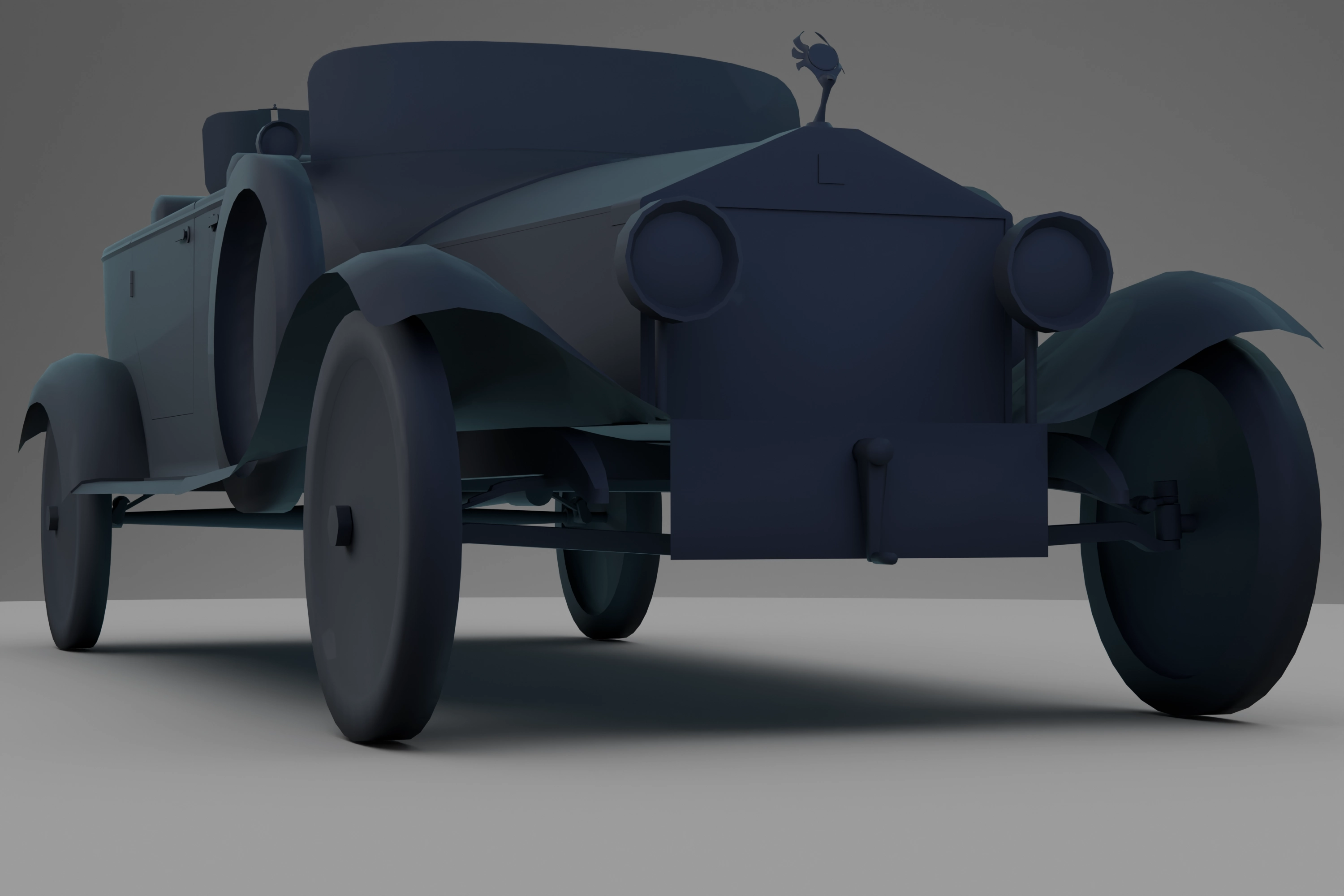
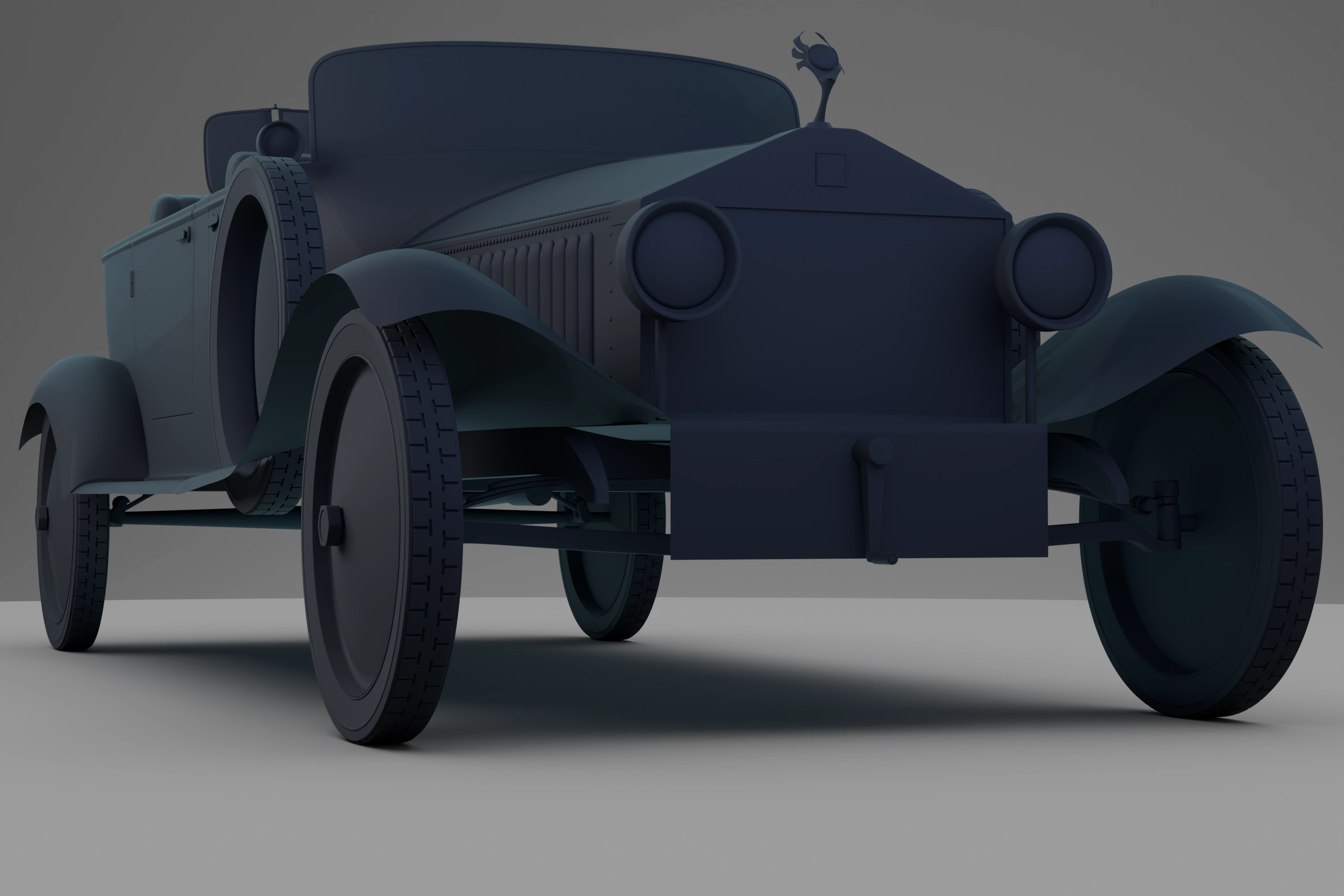
Sculpt against shipping mesh
Both in clay, so only the silhouette is left to compare — the one thing a normal map cannot carry and the budget was spent on.
High-poly clay · 54M
Low-poly clay · 26,504
1 / 6
What the sculpt bought
The same low-poly twice - once flat, once carrying the normal and occlusion baked off the sculpt. No colour, no roughness. This is the frame that justifies having built 54 million triangles.
Low-poly clay
Baked · normal + AO
1 / 3
Texturing
In progressWhere the detail that was cut from the mesh comes back. One set of maps doing the work of 54 million triangles.
Texture passes are not started.
Material passes
The map sets, and why there is more than oneIn progress — Resolutions and the full set list to be confirmed on the first pass.
Resolutions and the full set list to be confirmed on the first pass.
The doors carry two sets between them rather than one, because they are two materials that happen to share a hinge: the outer face is part of the painted shell and has to match it exactly, while the inner face is a wooden plate that has nothing in common with it. Sharing a set would mean either the paint or the grain losing resolution to the other.
Rig-ready delivery
An asset is only game-ready if it arrives correctly in the thing that opens it.
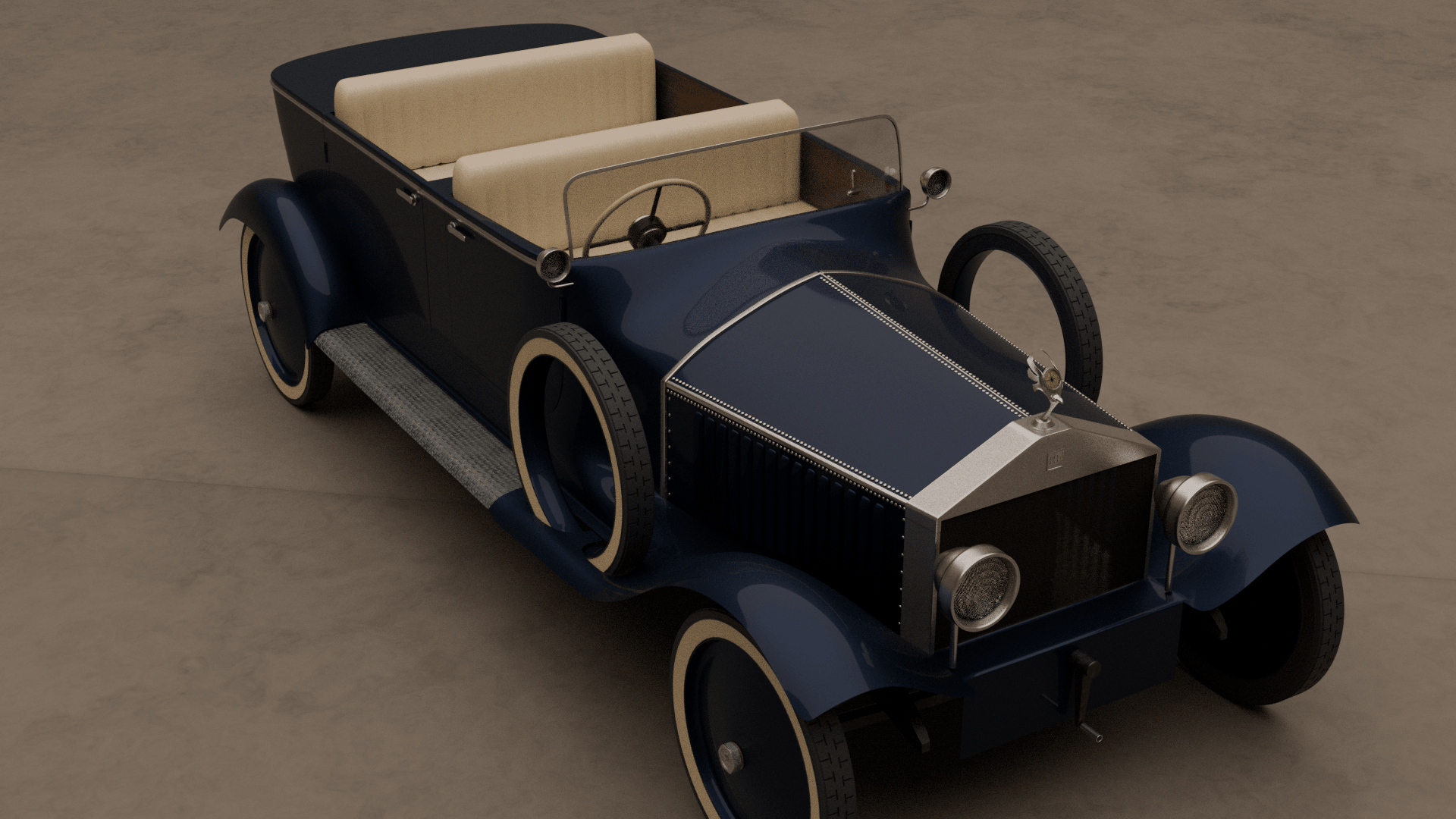
The finished modelIn progress — The live viewer arrives with the finished low-poly.
Turn it over yourself. The download carries the source files.
The live viewer arrives with the finished low-poly.
- Format:
- FBX · OBJ · glTF
- Licence:
- Royalty-free commercial
How it leaves BlenderIn progress — To be written on the first real export.
To be written on the first real export.
Right scale, right axis, transforms applied, and the moving parts - wheels, steering, doors - separated with their pivots where a rigger expects them. Everything above is wasted if this part is wrong, and it is the part nobody photographs.
Elsewhere
The finished thing, and the honest account of getting there.
- Download on Gumroad
Source files, full-resolution maps, and the licence.